

A painting exists in a different world, doesn't it? Literally and metaphorically, it lives on a different plane of existence, away from the hustle and bustle of our fast-paced lives, yet also away from the reality we inhabit, forcing us to look beyond and beneath. Andrew Graham-Dixon, the British art historian, critic and broadcaster, has spent his life studying and discovering this soundless yet melodious universe, with his latest work, Vermeer: A Life Lost and Found (2025), drawing on extensive historical research to revisit and reconsider the Dutch master's life, paintings and relationship with the religious and political conflicts of his time.
I sat down with him earlier this year amidst much chaos to talk about the stillness of his artistic pursuits, why paintings—both creating and observing them—are so critical in our age of AI and fleeting attention spans, why the Sistine Chapel was the first action comic book, the narcissism of modern museum visitors, and why intellectual autonomy of artists is so important today. Edited excerpts.
Amritesh Mukherjee: Is this your first time at the JLF? How has the experience been?
Andrew Graham-Dixon: No, it's the second time. I was here 15 years ago, so it's quite an interesting transition. It's busier, more vibrant, with many more events. It was smaller when I came before, much cosier and more homely, the Diggi Palace. It's still very friendly, but it has a buzz. People are really interested in their books.
AM: AI has changed how art is created, especially with corporations and private players commoditising it. All the emotions and stories behind art can seemingly be reduced to a prompt. How do you see this?
AGD: Artificial intelligence couldn't possibly have written my book because it can't think independently. One danger of artificial intelligence is that we already suffer from convention. If you're trying to have original thoughts, your enemy is convention and received ideas—what people have already thought. You have to unpick that, question it, and find new ways of thinking.
AI is very good at repeating what everyone has thought and making it look a little different—new in appearance but not new in reality. I hope my book offers something completely different: human intelligence, emotional intelligence, and a new way of thinking.
AM: In a period where images are cheap, and attention is rare, what does that do to the relevance of painting as a form that requires stillness?
AGD: I think it's like meditation or certain spiritual practices; you have to put your phone down and put everything away. If you want to participate, you have to give yourself up to the painting. If you can find five minutes of privacy in a museum, you can look at a painting and give it your full attention. Or you can do that at home by looking at a reproduction. For me, the true experience of looking at a painting and thinking about it is profoundly meditative.
You can, of course, use a photo app and make yourself Mona Lisa's boyfriend; you could be in the painting. That's not looking at a painting. If you go into art galleries where people can use their mobile phones, you often find people go straight to the most famous painting and stand with their backs to it. They take a photograph without looking at the painting.
I spent 10 years contemplating 30 pictures, and what came of it was a new awareness of the power of stillness and of the power of love to emanate from a painting and change a person. The paintings came from meditation, and they brought something I didn't know existed before: this profound love and desire to change society.
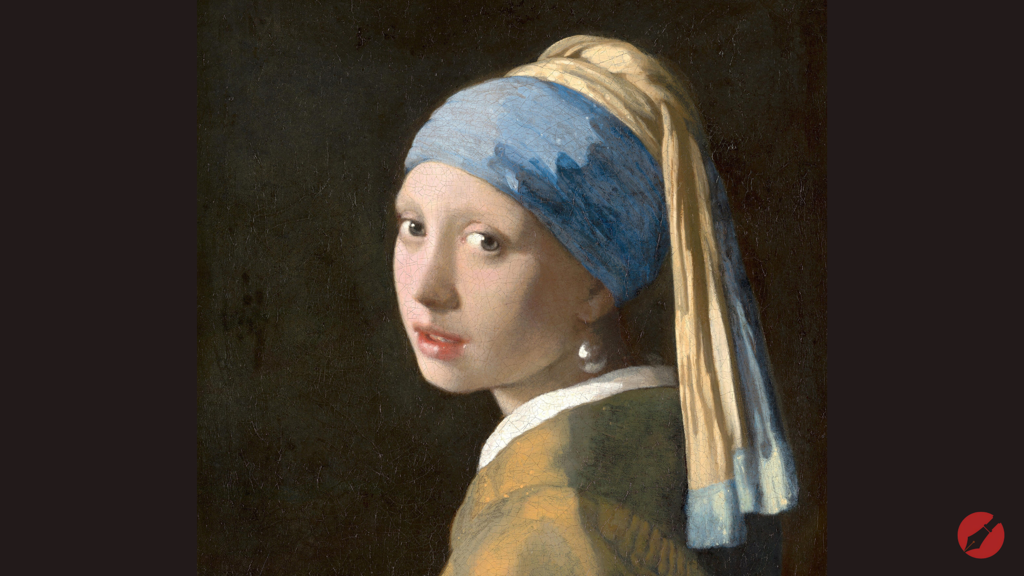
Girl with a Pearl Earring by Johannes Vermeer (1665)
When Vermeer painted those pictures, it was a time of terrible war—worse even than what we have today—conducted about religion. "I'm going to kill you because you're a Christian who believes something different from me," which is, of course, madness. But this madness was everywhere. And his pictures, like the books his friends wrote, ask: how do we stop this? Maybe if we take time, look inside our souls, and then behave well toward others—Vermeer's patron left most of her money for the war orphans. This only comes out of the pictures if you give them time, if you find out who knew Vermeer, who his friends were, what they were writing, what they believed—you can see it there. In my case, it's changed me as a person.
AM: You write about the modern narcissism of museum visitors—as you also just pointed out—who turn their backs on Leonardo or Michelangelo to take a selfie, treating art like a trophy. If you could ban smartphones in museums, would you?
AGD: Yes, I would. Smartphones shouldn't be allowed in museums. I think it's bad for people's mental health.
AM: You describe your book as a passport to open-mindedness. In an age of modern narcissism, how can a portable museum—a book—teach us other ways of seeing, where the physical museum is failing?
AGD: When you open a book, it's like opening a door or a window. Where you choose to go, that's up to you. But I hope my book is more like a door into a house, where you can choose from many rooms and do what you want. When an artist paints a picture, you can't control how people will receive it.
I hope people will explore the book and maybe find new things. I've received wonderful letters from readers, which made me think, "Oh, too late—that was a great idea, if only I'd thought that." A book will have its own life, as Vermeer's paintings do, obviously not as profoundly. But I hope my book can have that other life.
AM: In Michelangelo and the Sistine Chapel, you reject theologically totalitarian interpretations that suggest Michelangelo merely followed a program written by theologians like Giles of Viterbo. You argue that he was sufficiently well versed in theology to devise his own visual theology. Why has art history been so reluctant to grant visual artists the same intellectual autonomy?
AGD: That's a very good question. I think the answer is that aristocratic Englishmen originally invented art history, purely to tell them where their paintings were from. The idea was that the artist is a servant: he makes something for me, and I'm the important one. Art history is built on the idea that artists aren't very clever—they just specialise in making images, that it's kind of manual. Michelangelo was a poet; he was incredibly well read in scripture, and there's every chance he devised his own visual theology.
The more we learn about past artists, the more autonomy we discover they exercised. The great artists are like great philosophers—great thinkers, and they were recognised as such in their time, mostly, I believe.
AM: You've described Michelangelo's depiction of God flying through the air to separate light from darkness as the visual ancestor of Superman. Does that make the Sistine Chapel the world's first action comic?
AGD: It does, yes. The Sistine Chapel is, among many other things, the world's first action comic.
AM: What are you reading currently? And are you working on something right now?
AGD: I am working on a painting I discovered, and I can't talk about it. I hope that when I finish it, this completely unknown painting will become one of the most famous paintings in the world. I'm reading North Woods by Daniel Mason, and it’s a really good novel.