

The Nolan season is upon us! What is likely to be the grittiest, most grounded version of the Homeric epic is set for release within a month. For those yet to read the original text, this is the perfect time to start. Gods, souls, mystical creatures, magic, treachery — it’s all in there, and more. Ultimately, though, it’s the story of a man desperate to reach his home, to go back to his wife and son, come what may. That underlying human aspect is why The Odyssey has endured for centuries in various formats. It’s why it has found listeners and readers across cultures and time — the latest being Jorge Rivera-Herrans’s viral musical album, Epic, reimagining the poem for modern fans.
For readers, however, choosing the right translation can be tricky. The right translation can elevate your reading experience, while the wrong kind can leave you confused and disinterested. Through this piece, we’ll go through why picking the right translation of The Odyssey (and The Iliad, for that matter) matters more than you think. We’ll also compare the different translations and suggest which one might be the best for you to start your own odyssey.
The Quick Answer: Which Odyssey Translation Should You Pick?
| Motive | Best Translation |
| For the new reader | Emily Wilson |
| Close-to-Greek prose | Richmond Lattimore |
| Literary classic | Robert Fitzgerald |
| A sweeping and readable rendition | Robert Fagles |
| Contemporary performance | Stanley Lombardo |
| Prosaic | E. V. Rieu |
| Scholarly | Daniel Mendelsohn |
Why Is Picking the Right Translation of the Odyssey Important?
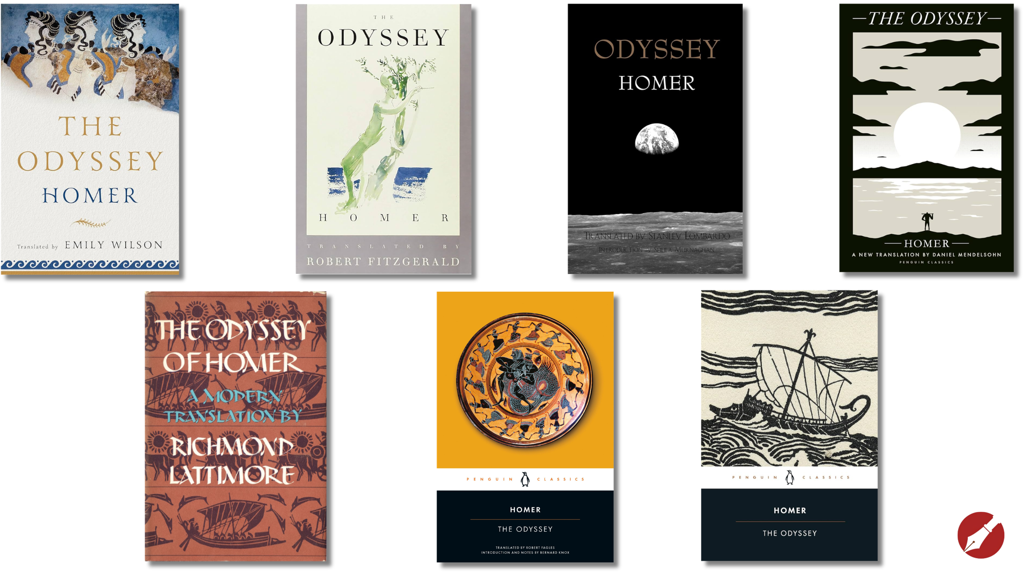
There are specific challenges in translating The Odyssey, which have led to over 60 complete translations of the epic in English alone. There are many choices for each translator to make, and every version, therefore, alters the very reading experience. Here are the main reasons:
1. Translating Poetry
The Odyssey predates the written word — it was an oral poem, passed down through generations of singers and performers (though there is no definitive proof that Homer ever wrote it or that there was ever a historical person named Homer). It’s meant to be sung, recited aloud. At the same time, most translations of The Odyssey are in prose format. The choices boil down to:
- Should I force a strict poetic meter?
- Should I just write in free verse?
- Should I go for a more accessible prose narrative?
- Should I go for archaic language to convey the grandeur of the original?
Over centuries, different translators have made different choices, leading to many options to choose from.
2. Naming Conventions
Many translations use Latin and Roman names for deities and characters (like Minerva instead of Athena and Jupiter instead of Zeus), a holdover from the European scholarly tradition of accessing Greek texts through Latin. This can be confusing to modern readers. It is, again, a choice for the translator to make whether to preserve the Greek names or translate them into the Romanised equivalents.
3. Repetition
The epic, given its origins in oral storytelling, frequently uses repetition and formulas to enhance recall. It allows the listener to recognise patterns and find rhythm, so as to memorise it more easily. Dawn is often described as rosy-fingered, the sea as wine-dark, Odysseus as godlike and resourceful, and Athena as owl-eyed. Similarly, daily schedules are repeated verbatim; plot points are recited over and over.
4. The Case of the Greek Ambiguity
Like most languages, Greek has several words and phrases that can mean different things depending on context. The very first line has the word “polytropos”, which has famously been tricky for the translators. The word literally means “many-turning”, and translators have gone with “cunning,” “wily,” and “skilled.”
5. The Gaze of the Present Day
Translations are often choices. Which word goes, which word remains, which word is invented — they are all choices for the translator to make. It’s natural, then, that the cultural conventions of the day would inadvertently leave their mark on a translation. Hence, Penelope is portrayed as softer than the Greek text would suggest in several translations. Other women characters are called overtly emotional, whores, sluts or bitches depending on who is translating.
Therefore, it’s necessary to remain cognisant of translation biases/choices and not to gloss over them when reading any edition.
Emily Wilson: The Best Translation of the Odyssey for the Modern Literary Reader

Image credits: Emily Wilson's website, photo by Kyle Cassidy
In the 21st century, many translations and interpretations of classics have been closely scrutinised and challenged. For one, most translators (like in other fields, creative or otherwise) have been men. Second, colonial undertones and whitewashings are commonplace in classical translations. Even something as recent as The Song of Achilles has racist and sexist undertones. Moreover, many epics and classics are force-fit into archaic English, even though the originals were written in simple, commonplace prose. Wilson rejects all that to bring a more modern, accessible version and avoids the misogyny rampant in many older versions (as we shall see later).
There’s a crisp, musical quality to her translation, which is written in iambic pentameter and ensures a smoother, emotionally grounded reading experience, perfect for a first-time Homer reader. It particularly showcases the power dynamics and violence inherent to the Homeric epics without imposing the colonial or patriarchal lens common to many Western translations. What makes her translation an achievement can, at times, also become its limitation. Certain phrases and lines can be relatively simplistic, stripped of their original complexity and ambiguity. For pace, clarity, and musicality, Wilson’s translation is a must-read.
Richmond Lattimore: The Best Translation of the Odyssey for the Greek-Facing Reader

Image credits: Rutgers-New Brunswick School of Arts and Sciences
Written in a six-beat free-verse style, Lattimore preserves Homer's repetition and formulaic phrasing, making it ideal for sensing the architecture of the Greek original. Relative to other, more readerly versions, this translation is less polished. Therefore, while it might not be the most poetic English poem, it maintains a strong fidelity to the original. There’s an eerie grandeur to his translation, the feeling of an ancient ritual being performed.
While the translation can be too clunky and obscure for the first-time reader, it's ideal for those wanting a closer-to-Greek feel. Compared with other translations, his version is less dramatic and slower, but its archaic, repetitive language makes it one of the most faithful renderings of The Odyssey in English.
Robert Fitzgerald: The Best Translation of the Odyssey for the Aesthete

Image credits: Miriam Champigny
A literary standard for many years after its publication, R. Fitzgerald’s Odyssey is written with the intention of creating a great English poem. This means that while his version may not be the best translation, it’s most certainly one of the finest transcreations of the Odyssey. His poem, in unrhymed, speech-driven verses, is alive and irresistible, much like the Homeric original. A poet himself, Fitzgerald knew how to create an atmosphere, something he does through his translation as well.
The above reasons are also why the translation might not be to everyone’s taste. He abandons the original’s penchant for repetition and formulaic phrases, often smoothing out ambiguities and adding elements of his own. For narrative momentum and an aesthetic poem that Homer himself might have crafted had he written in the language, Fitzgerald’s translation remains ideal after all these decades.
Robert Fagles: The Best Translation of the Odyssey for the Epic-Thrill Reader

Image credits: Bohemian.com
There are classics, and there are blockbusters. Robert Fagles’s translation is very much the latter, intentionally so. In his own words, he sought to find a middle ground between the performance-cadence of the original epic and accessibility for modern readers. His translation prioritises clarity and theatricality — ensuring the pace never overtakes the grandiosity, and vice versa. In many ways, his version was to his generation what Wilson’s is to ours. It captures the scale and grandeur of the original Greek while adding his own sense of drama and sonority.
While that might be perfect for many readers, he tends to alter the original freely wherever he sees fit. His bias for action can detract from the subtlety and ambiguity of Homer’s poem, thus creating a rendition that is somewhat distant in meaning and tone. At the same time, for its readability, poetic grandeur, vivacity, inventiveness, and performance-driven quality, Fagles’ version remains relevant despite the criticisms.
Stanley Lombardo: The Best Translation of the Odyssey for the Oral-Performance Reader

Image credits: GBP
You know how they say Shakespeare isn’t meant to be read but to be performed? Lombardo’s translation belongs to the same category. Written in a post-Vietnam, late-20th-century US setting, the work uses American colloquial speech, language, and behaviour associated with combat veterans. Just as the original Greek epic was an oral tradition before being written down, Lombardo initially wrote his version as scripts for a solo performance. It can be seen in the language, too — pacey lines, swift diction, distinct similes, modern phrasing.
His storytelling is urgent, an Odyssey with its breath caught in its throat. It’s also why his audiobook version (narrated by Lombardo himself) is highly praised and recommended, with its booming narration and atmosphere creating an unparalleled experience. However, as with many of the other translators, his strengths are also his weaknesses. The grandeur of the original is missing, as is its inherent ambiguity and sharp tone. Its colloquialism works brilliantly in some cases, horribly in others. That said, Lombardo’s version stands out for its handling of trauma and its use of repetition, as in the original, bringing forth a swift, dramatic tale perfect for the modern reader.
E. V. Rieu: The Best Translation of the Odyssey for the Plot-First Prose Reader

Image credits: Penguin Books
Some books you study, some you read. Some you open on a desk, some you carry to a train. E. V. Rieu’s rendition most certainly is the second kind. His translation was the first book under the Penguin Classics imprint and remained Penguin’s bestselling title for years. He was against archaic translations as they alienated modern readers and de-prioritised storytelling. His version is entirely in prose, bringing a sense of speed and narrative flair to the story — a foundational work that has been the entry point for many readers to Homer.
While his storytelling is brilliant, too much transcreation on his end also means that the translation is a product of his times. The mores of his era enter the story all too often, and the complex heroes and gods of the Homeric epics become domesticated, diminished versions of themselves. Essentially, the bardic grandeur, the ritual repetition, the moral ambiguity, the strangeness of the original — they all fade away here. Simultaneously, the plot emerges more clearly, creating an accessible version that is widely read even today.
Daniel Mendelsohn: The Best Translation of the Odyssey for the Advanced Formalist

Image credits: Matt Mendelsohn
The most recent translation of all we’ve covered, Mendelsohn's rendition goes against most of the choices Wilson — the most popular translator in recent years — made. His version is archaic with a hexameter echo, a line-for-line rendering that brings the sea-motion of the Greek into English. The Homeric sound patterns and density are preserved, and the translation is deliberately a more Greek-facing, slower, and sonorous piece. Somewhat akin to Lattimore’s translation, this version carries the poem's foreignness, unusual rhythms, and layered ambiguities.
While more formal readers would appreciate such stylistic choices, it can be slower and less accessible than other recent translations. For a smooth narrative pleasure or easy readability, Mendelsohn won’t be the right choice. But if you want the sound and mystique of the Greek original (with some hefty notes), this would be brilliant.
A Comparison of The Different Translators: Wilson vs Lattimore vs Fagles vs Fitzgerald vs Lombardo vs Rieu vs Mendelsohn
For our convenience and to avoid making this piece a novella, we will compare 5 instances in each translation to give you a better idea of the choices they make, which, in turn, will help you make the best choice.
The Beginning
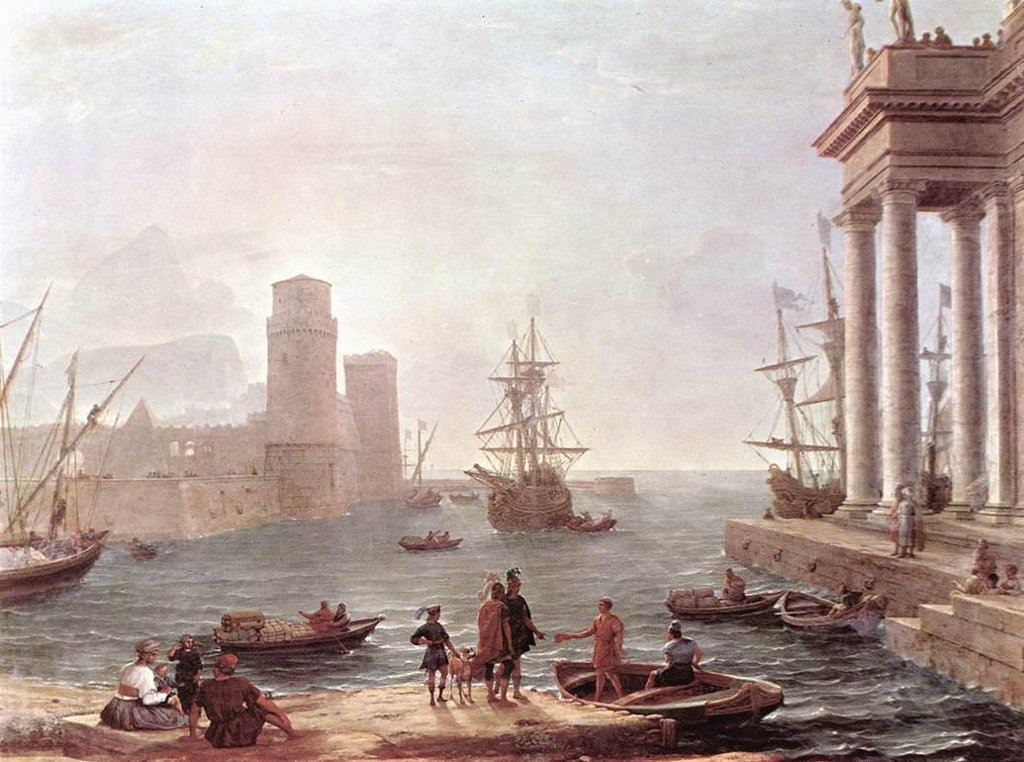
Image credits: Port Scene with the Departure of Ulysses from the Land of the Feaci by Claude Lorrain (1604)
The first is the opening scene itself, where the narrator seeks divine inspiration to begin the story of Odysseus:
ἄνδρα μοι ἔννεπε, μοῦσα, πολύτροπον, ὃς μάλα πολλὰ
πλάγχθη, ἐπεὶ Τροίης ἱερὸν πτολίεθρον ἔπερσεν:
πολλῶν δ᾽ ἀνθρώπων ἴδεν ἄστεα καὶ νόον ἔγνω,
πολλὰ δ᾽ ὅ γ᾽ ἐν πόντῳ πάθεν ἄλγεα ὃν κατὰ θυμόν,
5ἀρνύμενος ἥν τε ψυχὴν καὶ νόστον ἑταίρων.
Emily Wilson translates it as:
“Tell me about a complicated man.
Muse, tell me how he wandered and was lost
when he had wrecked the holy town of Troy,
and where he went, and who he met, the pain
he suffered in the storms at sea, and how
he worked to save his life and bring his men
back home.”
Richmond Lattimore, meanwhile, translates thus:
“Tell me, Muse, of the man of many ways, who was driven
far journeys, after he had sacked Troy's sacred citadel.
Many were they whose cities he saw, whose minds he learned of,
many the pains he suffered in his spirit on the wide sea,
struggling for his own life and the homecoming of his companions.”
The translation by Robert Fitzgerald reads like this:
“Sing in me, Muse, and through me tell the story
of that man skilled in all ways of contending,
the wanderer, harried for years on end,
after he plundered the stronghold
on the proud height of Troy.
He saw the townlands
and learned the minds of many distant men,
and weathered many bitter nights and days
in his deep heart at sea, while he fought only
to save his life, to bring his shipmates home.”
Robert Fagles translates it like this:
“Sing to me of the man, Muse, the man of twists and turns
driven time and again off course, once he had plundered
the hallowed heights of Troy.
Many cities of men he saw and learned their minds,
many pains he suffered, heartsick on the open sea,
fighting to save his life and bring his comrades home.”
Stanley Lombardo translates thus:
“SPEAK, MEMORY— Of the cunning hero,
The wanderer, blown off course time and again
After he plundered Troy’s sacred heights.
Speak
Of all the cities he saw, the minds he grasped,
The suffering deep in his heart at sea
As he struggled to survive and bring his men home”
E. V. Rieu’s translation reads:
“Tell me, Muse, the story of that resourceful man who was driven to wander far and wide after he had sacked the holy citadel of Troy. He saw the cities of many people and he learnt their ways. He suffered great anguish on the high seas in his struggles to preserve his life and bring his comrades home.”
Daniel Mendelsohn translates it as:
“Tell me the tale of a man, Muse, who had so many roundabout ways
To wander, driven off course, after sacking Troy’s hallowed keep;
Many the peoples whose cities he saw and whose ways of thinking he learned,
Many the toils he suffered at sea, anguish in his heart
As he struggled to safeguard his life and the homecoming of his companions.”
Homer leads his proem with the words ἄνδρα and πολύτροπον, treated distinctly by each translator. Wilson’s choice has been thoroughly discussed in recent times — “complicated man” being a modern psychologized term that removes the moral ambiguity of polytropos. At the same time, it also resists the tradition of heroizing and covers a lot of ground. Rieu also domesticates that word, going for “resourceful man,” which reads more like part of a novel than an epic. Meanwhile, Fitzgerald goes in the completely opposite direction — his “skilled in all ways of contending” is interpretive, while "Sing in me, Muse, and through me tell the story" is a mystical addition without any basis in the Greek.
Lattimore’s is the closest to the Greek structure, his “man of many ways” a literal rendering and his retention of the line architecture entirely faithful to the Homeric syntax. Fagles is also accurate with “twists and turns”, but the phrase adds a moral judgment, a sense of deviousness over ingenuity. Lombardo's 'SPEAK, MEMORY' likely echoes Nabokov's autobiography of the same name, a visible 20th-century literary imprint on an ancient text. Mendelsohn’s translation of polytropos as “roundabout ways” is highly accurate, though he translates ἱερὸν πτολίεθρον as “hallowed keep”, which trades the original’s solemnity for a hint of medievalism.
Homer’s proem has a rolling rhythm through repetition of πολλῶν/πολλὰ (many/much), creating a sequence of Odysseus’s movement through the years — to Troy, to cities, to suffering, to the sea, to his companions. Wilson trades all that for a narrative summary, which works as a spoken English piece but removes the ritualistic tenor of the original. Although occasionally awkward, Lattimore preserves the many… many… many… anaphora in his translation. Fitzgerald adds “bitter nights and days” and “deep heart”, elements missing in the original, but his priority is creating a poetic atmosphere, at which he’s successful. Fagles strikes a good balance between the two approaches; his “heartsick on the open sea” is an invention, but a tonally accurate one.
Lombardo’s fragmented, staccato structure creates additional drama but is alien to Homer’s metric. Rieu, with straightforward prose, steers clear of the original’s musicality. Mendelsohn’s is syntactically inventive; his "roundabout ways to wander" brings polytropos and planchthē into a single idiomatic phrase. It's a clever solution, though it softens Homer's distinction between who Odysseus is and what he endures. The targets are different for each translator and translation, some with higher fidelity to Homer’s meaning, some to his sound and rhythm, while some to modern accessibility, none hitting all three.
Calypso’s Island
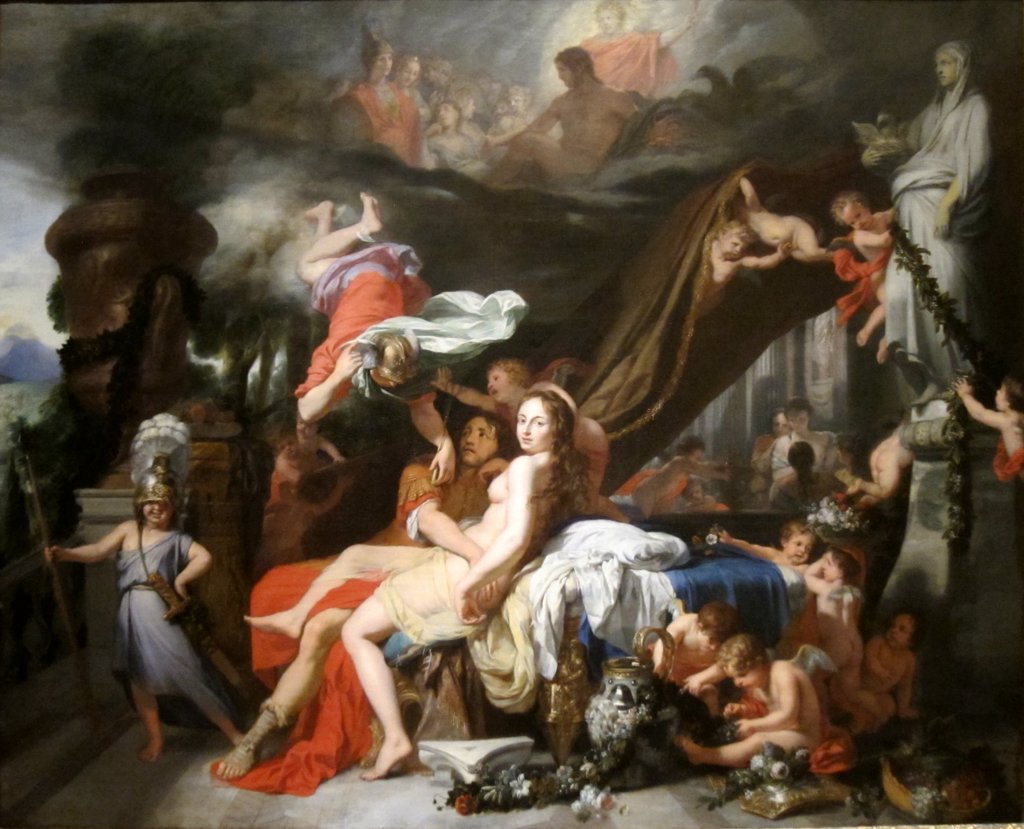
Image credits: Hermes Ordering Calypso to Release Odysseus by Gerard de Lairesse (1670)
The next is from the fifth book, when Hermes reaches Calypso’s island to instruct her to release Odysseus, who is weeping and vulnerable, a more intimate passage than the previous one:
οὐδ᾽ ἄρ᾽ Ὀδυσσῆα μεγαλήτορα ἔνδον ἔτετμεν,
ἀλλ᾽ ὅ γ᾽ ἐπ᾽ ἀκτῆς κλαῖε καθήμενος, ἔνθα πάρος περ,
δάκρυσι καὶ στοναχῇσι καὶ ἄλγεσι θυμὸν ἐρέχθων.
πόντον ἐπ᾽ ἀτρύγετον δερκέσκετο δάκρυα λείβων.
Emily Wilson translates it as:
“But Hermes did not find Odysseus,
since he was sitting by the shore as usual,
sobbing in grief and pain; his heart was breaking.
In tears he stared across the fruitless sea.”
Richmond Lattimore’s translation reads:
“But Hermes did not find great-hearted Odysseus indoors,
but he was sitting out on the beach, crying, as before now
he had done, breaking his heart in tears, lamentation, and sorrow,
as weeping tears he looked out over the barren water.”
Robert Fitzgerald translates it as:
“But he saw nothing of the great Odysseus,
who sat apart, as a thousand times before,
and racked his own heart groaning, with eyes wet
scanning the bare horizon of the sea.”
Robert Fagles’s rendition reads:
“But as for great Odysseus —
Hermes could not find him within the cave.
Off he sat on a headland, weeping there as always,
wrenching his heart with sobs and groans and anguish,
gazing out over the barren sea through blinding tears.”
Stanley Lombardo’s version goes:
“But Hermes didn’t find the great hero inside.
Odysseus was sitting on the shore,
As ever those days, honing his heart’s sorrow…”
E. V. Rieu translates it as:
“As for the lion-hearted Odysseus, Hermes did not find him in the cave, for he was sitting disconsolate on the shore in his accustomed place, tormenting himself with tears and sighs and heartache, and looking out across the barren sea with streaming eyes.”
Lastly, Daniel Mendelsohn translates it as:
“But Hermes did not find great-hearted Odysseus inside:
No, he was sitting by the shore and lamenting, as so often before,
Weeping and moaning and tearing his heart to shreds in despair.
The tears poured down as he stared at the restless wastes of the sea.”
The Greek lines here are sparse, built around the image of Odysseus missing from the cave, weeping, staring at the sea. The epithets μεγαλήτορα (great-hearted) for Odysseus and ἀτρύγετον (barren, unharvestable) for the sea are the primary forking points through the translations. Wilson doesn’t use any epithet for Odysseus, consistent with her stripping away the heroizing vocabulary of epics. Lattimore and Mendelsohn are faithful with “great-hearted”, while Fagles and Fitzgerald, interestingly, go for “great Odysseus.” Lombardo and Rieu make distinct choices, with the former going for “the great hero,” a phrase that loses the specificity of μεγαλήτορα. The latter writes “lion-hearted”, which makes it more familiar to English readers — 'lion-hearted' carrying echoes of Richard I and the broader English literary tradition — while veering away from the original.
For ἀτρύγετον, Wilson’s is the most accurate (“fruitless sea”; a-trygeton echoes trygaō, to harvest), with Rieu and Fagles going for “barren sea”, Lattimore with “barren water”, Fitzgerald with “bare horizon”, and Lombardo doing away with it altogether. Mendelsohn, however, goes with “restless wastes”, which changes the emotional texture of the phrase, from sterility to agitation.
The original’s ritualistic repetition (δάκρυσι (tears) across lines 3-4, the grief-words (δάκρυσι, στοναχῇσι, ἄλγεσι), and the image of tears literally falling (λείβων) into the barren sea) is faithfully reproduced in Lattimore’s rendition through the tricolon in "tears, lamentation, and sorrow." Both Wilson and Fitzgerald compress the scene; the former’s “his heart was breaking" is clean, and the latter’s "racked his own heart groaning" is elegant, but both lack the repetitive imagery of the original. Fagles makes the act more muscular and masculine with "wrenching his heart with sobs and groans and anguish," wrenching as a physical verb absent in Greek.
Rieu’s, as usual, is the smoothest; his “disconsolate” compresses the repetitive tear imagery. Lombardo’s “honing his heart’s sorrow” signals a kind of masochistic craftsmanship but works viscerally. Mendelsohn adds a touch of melodrama with "tearing his heart to shreds in despair", which, combined with “restless wastes of the sea”, is more intense than the Homeric stillness.
The Cyclops Saga
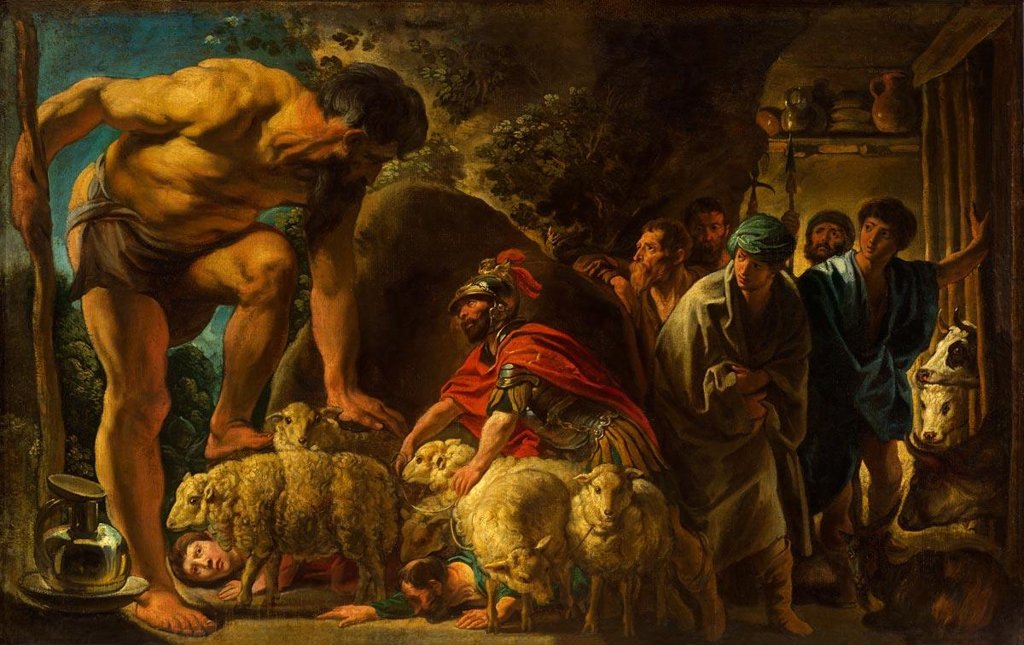
Image credits: Odysseus redt zijn metgezellen van Polyphemus door hen by Jacob Jordaens (1630-1635)
The next from book 9 is a case of Greek ambiguity, where Odysseus tricks the cyclops (the wordplay is in Οὖτις / Οὖτιν / Οὖτίς and later μή τίς):
Οὖτις ἐμοί γ᾽ ὄνομα: Οὖτιν δέ με κικλήσκουσι
μήτηρ ἠδὲ πατὴρ ἠδ᾽ ἄλλοι πάντες ἑταῖροι.
’
ὣς ἐφάμην, ὁ δέ μ᾽ αὐτίκ᾽ ἀμείβετο νηλέι θυμῷ:
‘Οὖτιν ἐγὼ πύματον ἔδομαι μετὰ οἷς ἑτάροισιν,
τοὺς δ᾽ ἄλλους πρόσθεν: τὸ δέ τοι ξεινήιον ἔσται.
’
(...)
τοὺς δ᾽ αὖτ᾽ ἐξ ἄντρου προσέφη κρατερὸς Πολύφημος:
‘ὦ φίλοι, Οὖτίς με κτείνει δόλῳ οὐδὲ βίηφιν.
’
‘
οἱ δ᾽ ἀπαμειβόμενοι ἔπεα πτερόεντ᾽ ἀγόρευον:
‘εἰ μὲν δὴ μή τίς σε βιάζεται οἶον ἐόντα’
Emily Wilson’s version reads:
“My name is Noman.
My family and friends all call me Noman.’
He answered with no pity in his heart,
‘I will eat Noman last; first I will eat
the other men. That is my gift to you.’ ”
(...)
Strong Polyphemus from inside
replied, ‘My friends! Noman is killing me
by tricks, not force.’
Their words flew back to him:
‘If no one hurts you, you are all alone.’”
Richmond Lattimore goes about it as:
“”Nobody is my name. My father and mother call me
Nobody, as do all the others who are my companions.”
‘So I spoke, and he answered me in pitiless spirit:
“Then I will eat Nobody after his friends, and the others
I will eat first, and that shall be my guest present to you.”
(...)
“Then from inside the cave strong Polyphemos answered:
“Good friends, Nobody is killing me by force or treachery.”
‘So then the others speaking in winged words gave him an answer:
“If alone as you are none uses violence on you””
Robert Fitzgerald translates it as:
“‘My name is Nohbdy: mother, father, and friends,
everyone calls me Nohbdy.’
And he said:
‘Nohbdy’s my meat, then, after I eat his friends.
Others come first. There’s a noble gift, now.’
(...)
“Out of the cave
the mammoth Polyphemos roared in answer:
‘Nohbdy, Nohbdy’s tricked me, Nohbdy’s ruined me!’
To this rough shout they made a sage reply:
‘Ah well, if nobody has played you foul
there in your lonely bed…’”
Robert Fagles’s version reads:
“‘Nobody —that’s my name. Nobody —
so my mother and father call me, all my friends.’
But he boomed back at me from his ruthless heart,
‘Nobody? I’ll eat Nobody last of all his friends —
I’ll eat the others first! That’s my gift to you!”
(...)
“‘Nobody, friends’ —Polyphemus bellowed back from his cave —
‘Nobody’s killing me now by fraud and not by force!’
‘If you’re alone,’ his friends boomed back at once,
‘and nobody’s trying to overpower you now.’”
Stanley Lombardo’s translation reads:
“‘Noman is my name. They call me Noman—
My mother, my father, and all my friends, too.’
He answered me from his pitiless heart:
‘Noman I will eat last after his friends.
Friends first, him last. That’s my gift to you.’
(...)
“And Polyphemus shouted out to them:
‘Noman is killing me by some kind of trick!’
They sent their words winging back to him:
‘If no man is hurting you…’”
E. V. Rieu’s rendition goes:
“My name is Nobody. That is what I am called by my mother and father and by all my friends.
The Cyclops answered me from his cruel heart. “Of all his company I will eat Nobody last, and the rest before him. That shall be your gift.”
“Out of the cave came mighty Polyphemus’ voice in reply: “O my friends, it’s Nobody’s treachery, not violence, that is doing me to death.”
“Well then,” came the immediate reply, “if you are alone and nobody is assaulting you…””
Ultimately, Daniel Mendelsohn renders it thus:
“‘No-One is my name. No-One is what people call me,
My mother and my father and all of my comrades, too.’
My words. And there came right away this reply from his pitiless heart:
‘I’ll eat No-One last of all, after the rest of his comrades.
First I’ll eat the others—that will be your guest-gift!’
(...)
“From inside the cave, mighty Polyphêmos made his reply:
‘Friends, No-One is killing me—by trickery, not force!’
They replied to him then, using words that flew toward him like arrows:
‘If no one is doing you harm while you sit there all by yourself—’”
This is one of the trickiest passages to translate because of the Greek puns: Οὖτις (Nobody) sounds identical to οὔ τις (no one/not anyone), and the Cyclopes' response, built on the conditional "if no one is hurting you," is grammatically meaningless. Fitzgerald makes the most visually idiosyncratic choice; the spelling signals a proper noun while the sound remains indistinguishable from 'nobody’. What the Greek original achieves through phonology, many translators achieve through rhythm and typography, with Fagles using italics and repetition. Wilson and Lombardo employ “Noman”, which works better as a proper noun but doesn’t connect as well as a pun.
The passage remains one of the most memorable comic scenes of Western literature, its meaning as important as its timing. Fagles’ "Nobody? I'll eat Nobody last" has a music-hall quality, while Fitzgerald’s "Nohbdy's my meat, then" works great as well. His subsequent "Ah well, if nobody has played you foul / there in your lonely bed" adds a layer of indifference from the other Cylopes, which, even though absent in Greek, works well tonally. Mendelsohn meticulously renders ἔπεα πτερόεντ᾽ (winged words) as "words that flew toward him like arrows", which most other translators ignore or compress.
Lombardo makes a thug out of the Cyclops (which is fitting for the character), making his lines extra punchy: "Friends first, him last. That's my gift to you." Rieu’s "if you are alone and nobody is assaulting you" reads as a logical conditional rather than a comic exchange, draining the scene of its timing. This is somewhat similar to Wilson’s clean but slightly duller "If no one hurts you, you are all alone.” While Lattimore preserves the original’s structure, it comes across as stiff and awkward: "If alone as you are none uses violence on you.”
The Siren Song
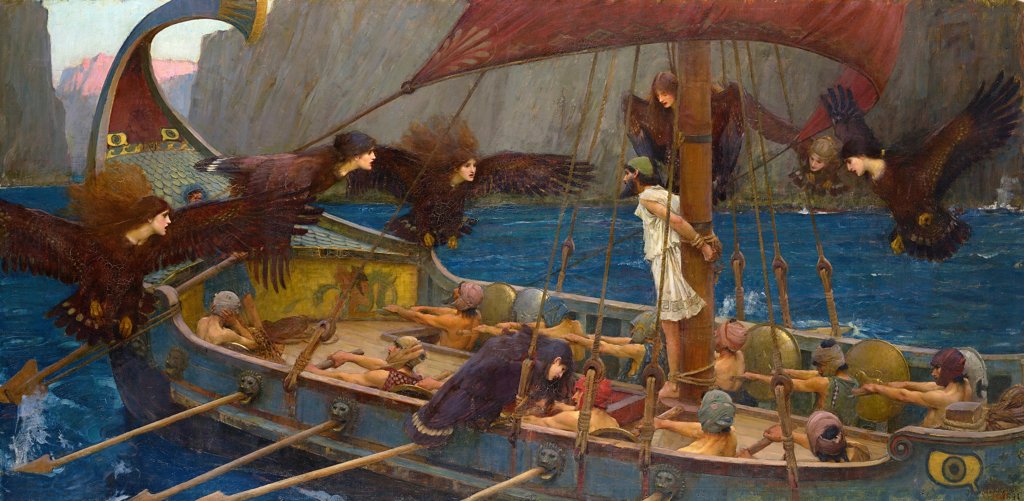
Image: Ulysses and the Sirens by John William Waterhouse (1891)
In the next scene from Book 12, the sirens try to lure with their song, and different translations go with different rhetorical interpretations:
δεῦρ᾽ ἄγ᾽ ἰών, πολύαιν᾽ Ὀδυσεῦ, μέγα κῦδος Ἀχαιῶν,
νῆα κατάστησον, ἵνα νωιτέρην ὄπ ἀκούσῃς.
οὐ γάρ πώ τις τῇδε παρήλασε νηὶ μελαίνῃ,
πρίν γ᾽ ἡμέων μελίγηρυν ἀπὸ στομάτων ὄπ᾽ ἀκοῦσαι,
ἀλλ᾽ ὅ γε τερψάμενος νεῖται καὶ πλείονα εἰδώς.
ἴδμεν γάρ τοι πάνθ᾽ ὅσ᾽ ἐνὶ Τροίῃ εὐρείῃ
Ἀργεῖοι Τρῶές τε θεῶν ἰότητι μόγησαν,
ἴδμεν δ᾽, ὅσσα γένηται ἐπὶ χθονὶ πουλυβοτείρῃ.
Emily Wilson translates it as:
“Odysseus! Come here! You are well-known
from many stories! Glory of the Greeks!
Now stop your ship and listen to our voices.
All those who pass this way hear honeyed song,
poured from our mouths. The music brings them joy,
and they go on their way with greater knowledge,
since we know everything the Greeks and Trojans
suffered in Troy, by gods’ will; and we know
whatever happens anywhere on earth.”
Richmond Lattimore renders it as:
“Come this way, honored Odysseus, great glory of the Achaians,
and stay your ship, so that you can listen here to our singing;
for no one else has ever sailed past this place in his black ship
until he has listened to the honey-sweet voice that issues
from our lips; then goes on, well pleased, knowing more than ever
he did; for we know everything that the Argives and Trojans
did and suffered in wide Troy through the gods’ despite.
Over all the generous earth we know everything that happens.”
Robert Fitzgerald’s translation reads thus:
“This way, oh turn your bows,
Akhaia’s glory,
As all the world allows—
Moor and be merry.
Sweet coupled airs we sing.
No lonely seafarer
Holds clear of entering
Our green mirror.
Pleased by each purling note
Like honey twining
From her throat and my throat,
Who lies a-pining?
Sea rovers here take joy
Voyaging onward,
As from our song of Troy
Greybeard and rower-boy
Goeth more learnèd.
All feats on that great field
In the long warfare,
Dark days the bright gods willed,
Wounds you bore there,
Argos’ old soldiery
On Troy beach teeming,
Charmed out of time we see.
No life on earth can be
Hid from our dreaming.”
Robert Fagles translates it as:
“Come closer, famous Odysseus —Achaea’s pride and glory —
moor your ship on our coast so you can hear our song!
Never has any sailor passed our shores in his black craft
until he has heard the honeyed voices pouring from our lips,
and once he hears to his heart’s content sails on, a wiser man.
We know all the pains that the Greeks and Trojans once endured
on the spreading plain of Troy when the gods willed it so —
all that comes to pass on the fertile earth, we know it all!”
Stanley Lombardo goes about it thus:
“Come hither, Odysseus,
glory of the Achaeans,
Stop your ship
so you can hear our voices.
No one has ever sailed
his black ship past here
Without listening to the honeyed
sound from our lips.
He journeys on delighted
and knows more than before.
For we know everything
that the Greeks and Trojans
Suffered in wide Troy
by the will of the gods.
We know all that happens
on the teeming earth.”
E. V. Rieu’s rendition reads:
“Draw near, illustrious Odysseus, man of many tales, great glory of the Achaeans, and bring your ship to rest so that you may hear our voices. No seaman ever sailed his black ship past this spot without listening to the honey-sweet tones that flow from our lips and no one who has listened has not been delighted and gone on his way a wiser man. For we know all that the Argives and Trojans suffered on the broad plain of Troy by the will of the gods, and we know whatever happens on this fruitful earth.”
And lastly, Daniel Mendelsohn translates it this way:
“O Odysseus, rich in praise, great glory of the Achaeans,
Come hither now, halt your ship and hear the sound of our voice!
For no one has ever rowed past us aboard his black-hulled ship
Before he’s heard the voice from our lips with its honeyed harmonies.
But once he has taken his pleasure, he returns knowing so much more.
For well we know all the hardships that there, in Troy’s sprawling plains,
Both the Argives and the Trojans endured through the will of the gods.
And we know whatever happens on the earth, which nourishes all.”
Every word of the sirens’ speech is meant to seduce and lure the listener, and translating the scene means making choices. The opening address is the first test: πολύαιν᾽ Ὀδυσεῦ, μέγα κῦδος Ἀχαιῶν or "much-praised Odysseus, great glory of the Achaeans," a double flattery. Most translators preserve the epithets: Lattimore's "honored Odysseus, great glory of the Achaians," Fagles' "famous Odysseus — Achaea's pride and glory," Mendelsohn's "rich in praise, great glory of the Achaeans" (the most literal of all, since πολύαιν᾽ means something like "of many praises"). Rieu translates it as "illustrious Odysseus, man of many tales," in which the second phrase is interesting, as it imports the epithet polytropos from elsewhere in the poem.
Wilson goes with "You are well-known from many stories! Glory of the Greeks!", her exclamation marks replacing the epic formulas, making the sirens more eager than enticing, modernising the address while softening its danger. Lombardo cuts to "glory of the Achaeans" and marches on, true to his rhythmic style. The Sirens' closing boast, that they know everything that happens on the nourishing earth, has sharper distinctions amongst the translations. Fagles translates it as "fertile earth" for πουλυβοτείρῃ (many-nourishing), which is accurate, while Mendelsohn's "earth, which nourishes all" is the most faithful. Meanwhile, Rieu's "fruitful earth" is pleasant but generic, and Wilson's "whatever happens anywhere on earth" comes across as flat and more administrative.
Fitzgerald's translation is the most distinct here, for he renders the original song into a new song of his own, in rhyming verse with a ballad-like meter. It’s the most distinct interpretive decision, which, while adding musicality and magic, comes at the cost of fidelity. At the same time, the addition works because it captures the charm and pull of the sirens, something none of the remaining translators could achieve. Fagles and Lombardo’s versions are the most dramatic, with the former’s “we know it all!” finishing on a showman’s note. Mendelsohn and Lattimore remain the most faithful in structure and meaning, while Rieu only captures the logic (and none of the musicality) of the sirens’ song. Wilson’s rendition removes the mysticism and casts the sirens less as predators than as eager informants, which is likely a deliberate feminist reframing on Wilson's part, though the flatness of modern English may also be a factor. Each translator, in the end, writes a different set of sirens and, in doing so, reveals something about their own choices.
Where the Housemaids Become Whores
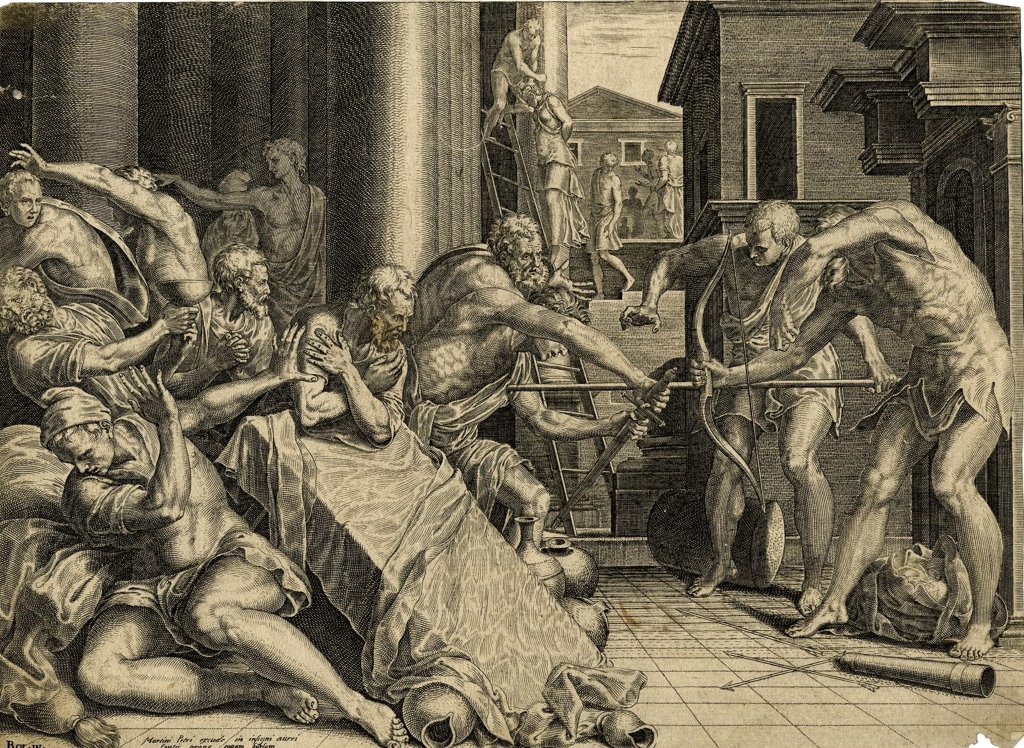
Image: Ulysses and Telemachus attacking and slaying the suitors by Francesco Primaticcio (1530-1560)
The last is from book 22, where Telemachus essentially pronounces the death sentence of the disloyal housemaids, a politically charged and uncomfortable moment:
τοῖσι δὲ Τηλέμαχος πεπνυμένος ἦρχ᾽ ἀγορεύειν:
‘
μὴ μὲν δὴ καθαρῷ θανάτῳ ἀπὸ θυμὸν ἑλοίμην
τάων, αἳ δὴ ἐμῇ κεφαλῇ κατ᾽ ὀνείδεα χεῦαν
μητέρι θ᾽ ἡμετέρῃ παρά τε μνηστῆρσιν ἴαυον.
’
Emily Wilson’s version reads thus:
“Showing initiative, Telemachus
insisted,
“I refuse to grant these girls
a clean death, since they poured down shame on me
and Mother, when they lay beside the suitors.”
Richmond Lattimore’s translation goes:
“Now the thoughtful Telemachos began speaking among them:
‘I would not take away the lives of these creatures by any
clean death, for they have showered abuse on the head of my mother,
and on my own head too, and they have slept with the suitors.’”
Robert Fitzgerald renders it as:
“Telémakhos, who knew his mind, said curtly:
“I would not give the clean death of a beast
to trulls who made a mockery of my mother
and of me too—you sluts, who lay with suitors.”
Robert Fagles’ version goes like this:
“stern Telemachus gave the men their orders:
“No clean death for the likes of them, by god!
Not from me —they showered abuse on my head,
my mother’s too!
You sluts —the suitors’ whores!”
Stanley Lombardo’s version reads:
“And Telemachus,
In his cool-headed way, said to the others:
“I won’t allow a clean death for these women—
The suitors’ sluts—who have heaped reproaches
Upon my own head and upon my mother’s.”
E. V. Rieu’s translation goes like this:
“Then the thoughtful Telemachus spoke.
‘I swear I will not give a decent death to women who have heaped insults on my head and on my mother’s, and slept with the Suitors.’”
Ultimately, Daniel Mendelsohn translates the lines thus:
“Telémakhos, sensible lad, began to speak to them then:
“Let the death that I inflict on these women not be a clean one!
For they poured upon my head an endless stream of insults—
And on my mother, too—while they were sleeping with the Suitors.””
The first major word here is πεπνυμένος for Telemachus, meaning thoughtful, of sound mind. Lattimore chooses "thoughtful"; Rieu "thoughtful"; Mendelsohn "sensible lad" (the most literal and also the most boyish; "lad" slightly infantilises a twenty-year-old); Lombardo "cool-headed"; Fagles goes with "stern." Wilson, however, replaces the epithet with "showing initiative", a phrase that reframes Telemachus's intervention: it shifts the moral framing from prudence (this is the wise thing) to decisiveness (this boy is taking charge).
Where they diverge the most is in how they characterise the women, a subject of pointed critical debate, particularly since Wilson's translation brought it into wider public conversation. Fitzgerald goes for both the archaic ('trulls') and the modern ('sluts'); Fagles goes furthest, the exclamation points and direct address ("You sluts") have Telemachus turning to face the women mid-speech, a theatrical and viscerally ugly scene that foregrounds the misogyny of the translation. Lombardo, too, goes with sluts, while Mendelsohn and Rieu keep it “women.”
Lombardo's "suitors' sluts" and "cool-headed" create a weird combination, with the detachment of "cool-headed" making the act seem casual and bureaucratically cruel. Lattimore, interestingly, translates it as “creatures”, veering away from the original’s “them”. Moreover, Rieu’s “decent death” instead of “clean death” adds a layer of moral judgment. Where Homer's Telemachus is saying I will not kill you in the warrior's way, Rieu's Telemachus is saying something closer to you do not deserve the dignity of a proper death. Wilson keeps it clinical with "these girls", a translation choice that reframes the power dynamic, reminding us these are young, enslaved women with no real choice in the matter.
To Be Lost Is To Be Found
Every translation is an argument. An argument about what Homer means, what language can do, and, perhaps most importantly, what the translator believes the reader deserves. Wilson believes they deserve honesty. Lattimore believes they deserve proximity to the Greek. Fitzgerald believes they deserve a great poem. Fagles believes they deserve a spectacle. Lombardo believes they deserve urgency. Rieu believes they deserve a story. Mendelsohn believes they deserve all of it, at whatever cost to readability.
While none of them is wrong, none of them is complete. That is the nature of translation, and, perhaps, of the Odyssey itself, a poem that has survived because it cannot be pinned down. Pick the one that speaks to you and let it sing to you the story of the man of many ways.