
The internet is crazy. Aren’t we, too, though, we, the builders and users of the internet? We spend hours glued to a black brick, willingly outsource our cognition to a generative tool, participate in the game of one-upmanship all the time, not to mention the relentless sociopolitical posturing. But how did we come here? How did an entire generation adopt identities handed out by a random app?
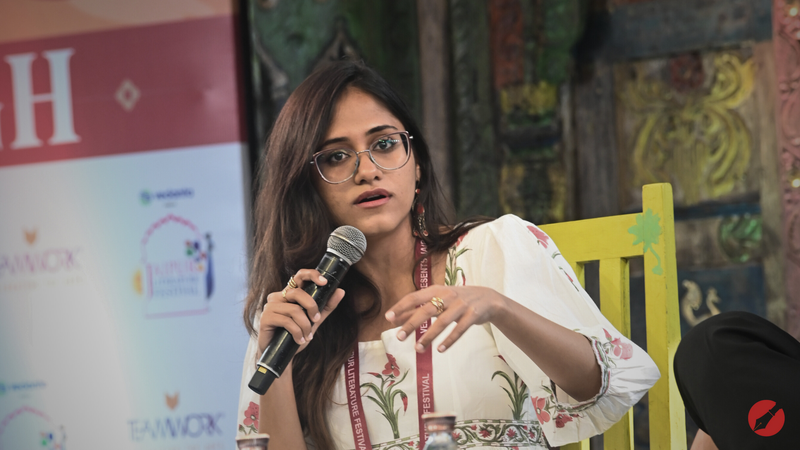
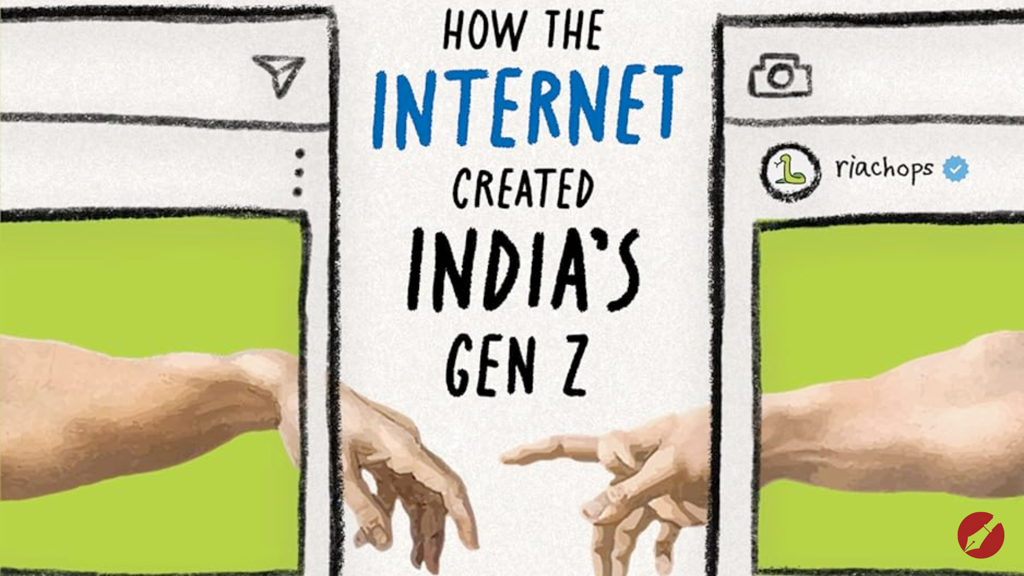
Ria Chopra writes frequently on pop culture and the Gen Z (alongside a thriving stint as an Instagram influencer @riachops) and her debut book, Never Logged Out, is the story of a generation shaped by the internet and a generation that, of course, helped shape it in turn. Through a collection of essays, she explores wide-ranging topics, from relationships to cinema, from tote bags to online trolling. I had a riveting, fun conversation with her at the Jaipur Literature Festival 2026, and I’m sure you’ll enjoy it as much as I did. Edited excerpts:
Amritesh Mukherjee: Is this your first time at the JLF? How has it been?
Ria Chopra: 100% first time. It’s a lot. They call it Asia’s largest festival, and my editor has been calling it the Met Gala of the publishing industry. Thankfully, I’ve done a few smaller festivals before this, and I do events in general; otherwise, this would be overwhelming. As a first-time author and also as a woman in these spaces, there’s a performance pressure that comes into it.
I have to prove that I’m smart enough to belong here. Thankfully, the session went very well. I’m glad I get to do it with Anurag (Minus Verma) and Chirag (Thakkar). We’ve become friends, and it’s good to have a couple of people I know; that becomes the safe space.
AM: Coming to your book, you discuss how we have moved from being a type of person to looking like that type of person via consumption (e.g., carrying a specific tote bag to signal literary taste). Do you believe this shift to "aesthetic" over "essence" has fundamentally hollowed out the process of identity formation for Indian Gen Z, or is it simply a new language of self-expression we haven't learned to read yet?
RC: It is coming from a gap in our identity formation. There is a question of who I am, what is me, what does that mean, and the easy access to objects, the amount of consumerism we see around us, and the association of that object to certain kinds of identity gives us a shorthand to show the world who we are, versus taking the time to figure out who I am without that object. My tote bag, for instance, from a very niche bookstore, would show everybody that I’m a book connoisseur, versus having to prove in conversation that I’m a well-read person.
It is easy to use shorthands; that’s why we do them. This is not just an internet phenomenon; it has been happening for a while, but it has been supercharged. It further perpetuates the cycle because now the tote bag is not enough. Now I need a first edition, I need an advance reader copy, which I’ve realised is a huge status symbol. That cycle perpetuates itself. It’s going to get worse if we don’t stop to think about it. It’s become very individualistic to look at it as a me problem. Look at the environmental effects. Is my identity more important than the world? I don’t think so.
AM: Do you think this has led to a decline in activism, where urgency comes from local grassroots movements, but we’re now mired in a global identity cycle? On one Instagram story today, you see the genocide happening in Gaza, and in the next, you see someone trying out the latest outfit of the day.
RC: The internet has enabled mobilisation to some extent. During the CAA and NRC protests, a lot of information was shared online. During COVID, I got an oxygen cylinder through the internet; it wouldn’t have happened otherwise. Influencers were sharing people’s posts. That is an important part of activism, and it does come from the grassroots. At the same time, social media, especially because of algorithms and shadow banning, sometimes reduces activism to the lowest common denominator.
I mention this in my book: the easiest post to share to show that you care about activism was the AI-generated All Eyes on Rafah post. Rather than sharing resources or donation links, if you think posting a black square is enough, which a lot of white celebrities were doing, that signalling without engaging with the grassroots is the problem. If you’re using social media for amplification and also doing something on the ground, there is no problem.
That actually helps amplify movements, and journalists and activists use it too. During the farmers’ protest, creators with followings from Delhi were posting because mainstream media wouldn’t show it. That’s important. But negating the underlying causes, staying on the surface, that is the problem.
AM: You reference Russell W. Belk’s theory of the "extended self" to explain how we incorporate digital possessions into our identities. If our digital footprints and "lore" are now extensions of our physical bodies, does the "right to be forgotten" become a form of digital amputation? How do we reconcile the need to delete parts of our online history with the feeling that we are deleting parts of ourselves?
RC: A lot of people are going to have to start caring about this now. Friends of mine, when applying for a US visa, think about deleting their Twitter because your footprint is there for a reason, versus the real consequences of what you said. I also talk about this in my book: if you’re not the same person you were back then but someone dredges up an old tweet or screenshot, how do you reconcile that this was also yourself, even if it’s not anymore?
The right to be forgotten becomes a personal choice. There isn’t a one-size-fits-all approach. There are nice parts of my life online. I like seeing myself grow up on Instagram, but now that I’m a public figure, I’ve archived a lot of posts because I don’t want everyone to see them. Deletion doesn’t always mean personal forgetting; it can mean public erasure.
Archiving lets me access it while others can’t. Deleting altogether can be a powerful act of saying I don’t want to see this anymore. A friend deleted his entire Google Drive, WhatsApp, everything—saying whatever was here has been used, it’s done. I couldn’t do that. A friend of mine passed away during COVID, and I want to keep our WhatsApp chats. These choices—forgetting, archiving, saving, preserving—should always be personal. It’s like street photography: without consent, it’s a problem; with consent, it’s an extension of you.
AM: You note that Indian Gen Z specifically straddled three eras: an offline childhood, a transitional adolescence where the internet was a "tool," and an adulthood where it is a "habitat". How does this unique "triality" create a psychological profile for Indian Gen Z that is distinct from Western Gen Z, who may have been "born online"?
RC: There’s a secondary distinction, too. Much of the West got internet access at the same time, so Gen Z in America has been online for roughly the same duration. Here, I got internet in 2004–05, while someone born in a rural part of the country got it much later. That’s a 10–12 year head start. We’re fragmented and different, as Anurag mentioned on stage.
Having spent years offline, our brains still remember how things used to be. Teenagers—I love them—but they operate on a very different frequency. Someone ten years younger today feels unrelatable, while someone ten years older feels easier to talk to because we roughly had the same amount of time online. Younger generations will have far more exposure, especially with AI-generated content. When you enter the internet matters. Having had an offline sense of self makes us better equipped. Does it mean we don’t succumb to it? No, because we were still malleable when we entered, and hence have been shaped by it. We’re a bridge generation.
AM: I liked your parallel between optimizing cultural consumption (checking restaurant ratings) and optimizing love (checking for "red flags" or the "orange peel theory"). You argue that this prevents us from developing genuine "taste." But if we stop treating romance as a management consultant's problem statement, what does "developing taste" in love look like in a digital age? Does it require us to willingly embrace the "bad experience"?
RC: I don’t mean embracing abuse. Ek do baar dil toot jaye toh bahut seekhne ko milta hai. A few bad experiences teach you your triggers. You’re not your best self when you’re angry or upset, and understanding how you react helps you choose better. It’s like knowing what a rotten avocado looks like before buying a good one. Wanting only good experiences is unrealistic. It shows up in art, romance, and how we talk about them.
That optimisation will lead to a very singular understanding of what is actually a very nuanced experience. Not all good movies are good movies, much the same way that the person you love the most is also not. Sometimes you do get angry with them. If you don’t know how to handle that because you expected roses and butterflies, you won’t know how to operate in the grey areas. You can’t escape that when in love.
There’s a conversation to be had about how dating apps remove the social codes of conduct we have with each other. If I meet a guy through a friend, that guy is in some way beholden to be nice to me because we want to keep our friendship, versus meeting someone on a dating app who now has free license to do whatever. The tech world perpetuates bad experiences like that, and it’s important to critique that. But does that mean we avoid the bad altogether?
AM: Do you think it comes back to that basic unitary motivation of social media companies to “remove boredom” from our lives?
RC: They’re all built on the slot-machine aesthetic of Vegas casinos, keeping you waiting for the next dopamine hit. It’s pervasive across all kinds of apps.
AM: You speak lovingly of the quizzing subculture and "funda-based" questions. Do you fear that the instant gratification of Google and AI answers is killing the joy of the "funda," that narrative journey of figuring things out?
RC: Aspiring writers often ask me about writing with AI. What makes you a writer is not having a written thing at the end, it’s the process of writing. This book changed my life. The book comes at the end of it, but the process of being changed is what made me a writer. That is what a funda-based question does—it’s not about the answer, it’s about that process.
When you go to the gym, you are stretching your muscles, making them stronger, and getting swole is a good thing, but it is the strength that is important. If we remove strength, if we remove critical thinking, if we accept the first thing that is shown to us, not only are we missing out on joy, we are also dulling the capability of our future selves to realize when something is fake news.
Being comfortable with the process and using our brains as much as possible is really important. I am grateful to have an outlet like quizzing. Reading clubs, even learning languages through Duolingo is fine. Do crosswords, do Sudoku, whatever you find. Exercising brain muscles is supremely important.
AM: Should education policy change to reflect this reality? While our current system is based on learning and roting, AI has made a lot of that obsolete. Should the system then need to be changed to adapt to AI? Or should we be focusing more on how to place railroads on AI to ensure that the current system can keep operating?
RC: All of us who have gone through it know that the current system is too bad. It is not so much learning as rote and revision. There is room for change, but that change is not AI. It’s being used in places like healthcare for quite interesting things, like personalization of medical journeys. Personalization of learning journeys could be an interesting thing to do, but a huge part of going through school and learning is also people.
It’s having a good teacher, good peers, learning social interaction, which a lot of young kids don’t have in real life anymore, because you come home, you have devices, then you have gymnastics class, then your parents send you on one play date with one friend. Emphasizing far more on the human aspect is important.
Also, AI is a strange word. It’s the same 5 VC companies investing in the same 5. Now Google and Apple are colluding, and ChatGPT is doing something with Apple. I am deeply uncomfortable with that nexus because those outside of us don’t have any visibility on what’s going on. They are also not free of biases or free of factual inaccuracies. So, bringing that into education won’t be great, not as of now.
AM: What are you reading right now? Do you have a next in mind?
RC: I just finished Anurag Minus Verma’s The Great Indian Brain Rot, which I quite liked. I am currently reading Rejection by Tony Tulathimutte, a collection of internetty short stories. I am going to pick up Manu Joseph’s Why the Poor Don’t Kill Us. The Loneliness of Sonia and Sunny is intimidating me by sitting on my table, but I will also make my way through that.
The sessions here gave me a lot of visibility on new books. For instance, I read Amrita Mahale’s Real Life, which I enjoyed. She had a panel with Bhavika Govil and Shunali Khullar Shroff, and I am going to pick up their books, too. A lot of JLF books are now on my table.
I do not have a next in mind. This book took everything out of me, like an exorcism of things I have held on to for years. It was therapy and processing, like an outpouring, and I am very empty right now. There was a period of time when this book was getting rejected by a few publishers, so I started writing a fiction book. I am 5000 words into a draft there, but then this book happened, so it took over.
AM: Never say never!
RC: Yes!