
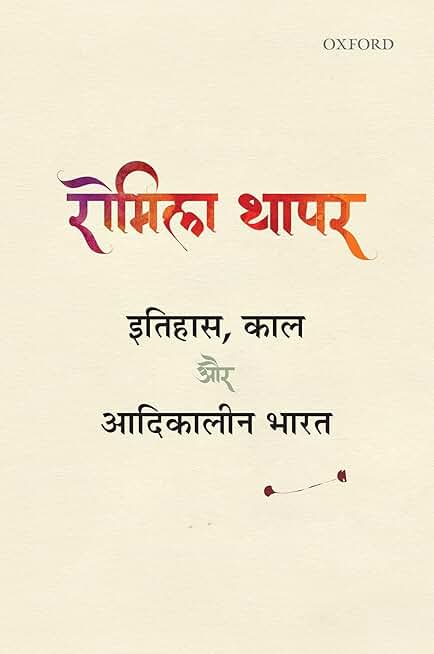
ITIHAAS, KAAL, AUR ADIKALIN BHARAT P
Romila Thapar challenges a stubborn assumption about early Indian civilisation in this fascinating exploration of time and historical thinking. Scholars long claimed that ancient India only understood time as cyclical, endlessly repeating itself without linear progression. Worse, they suggested that Indians showed little interest in history itself. Thapar dismantles both ideas persuasively. She uncovers compelling evidence that early Indian thinkers actually worked with two contrasting models of time simultaneously. Genealogies, biographies, and chronicles reveal a linear conception of duration, measured in generations, royal reigns, and named eras. Yet cyclical time wasn't abandoned; rather, it served a different purpose. When contemplating cosmic origins and creation, Indians reached for the circular model. When recording actual events and rulers, they adopted the linear one. What emerges is a portrait of ancient India brimming with historical awareness. Rather than dismissing the past as mere repetition, these societies documented change, tracked succession, and preserved memory. Thapar's argument rests on close reading of primary sources, making a compelling case that historical consciousness flourished in India far earlier than once believed. A corrective to Western scholarship that sorely needed writing.
- Author: Romila Thapar
- Publisher: OUP India
- Genre: Astronomy & Space Science
- ISBN: 978-0199485215
- Pages: 88 pages