
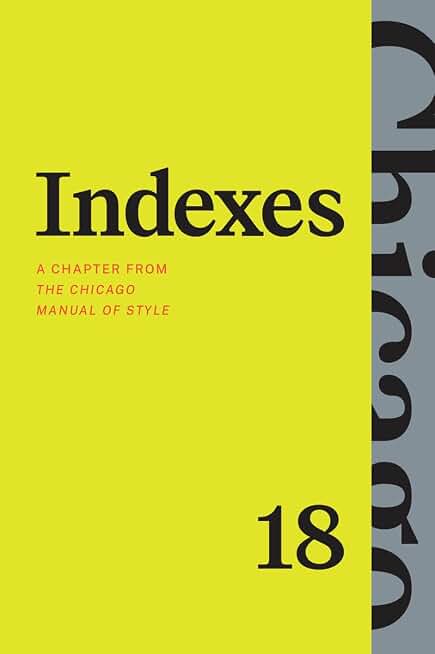
Indexes: A Chapter from "The Chicago Manual of Style," Eighteenth Edition
Drawn from one of the most trusted references in publishing, this compact chapter-length guide covers the full process of building a book index, from first principles to finished product. It's a surprisingly rich read for something so niche. The booklet opens with a question worth sitting with: do we still need human-made indexes when almost every text can be searched digitally? The answer, it turns out, is yes. A well-constructed index does things a search bar simply can't. It brings together related subjects, arranges them in a logical order, points readers towards connected terms, and provides reliable locators throughout the text. For digital formats, it goes further still, offering direct links rather than dead ends. Far from being a relic, a thoughtful index is what stands between a reader and a frustrating, fruitless hunt through pages. There's also a practical urgency to this work that the guide handles honestly. Most indexes have to be pulled together in roughly four weeks, squeezed into the narrow window between page proofs going out and coming back to the typesetter. Authors indexing their own books face the added pressure of proofreading at the same time. That's a tight schedule, and knowing how to work efficiently within it matters. Whether you're a seasoned professional or tackling your first index, this guide offers clear, grounded direction that respects both the craft and the reader it ultimately serves.
- Author: University of Chicago Press Editorial Staff
- Publisher: Univ of Chicago Pr
- Genre: Journalism & Media Studies
- ISBN: 978-0226837680
- Pages: 64 pages