
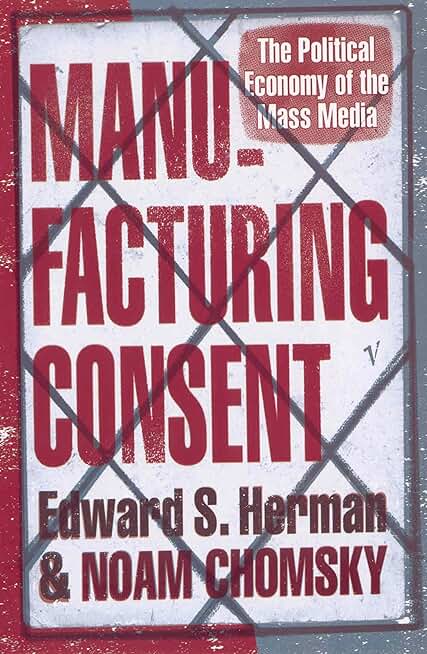
Manufacturing Consent: The Political Economy of the Mass Media
Few books about the press manage to be genuinely unsettling, but this one earns that distinction. Edward S. Herman and Noam Chomsky set out to examine how mainstream media really operates, and what they uncover is not reassuring. Their central argument is that an implicit elite consensus quietly shapes which stories get told, how they are framed, and which facts are quietly set aside. The economics of publishing, it turns out, do a great deal of the editorial heavy lifting. The authors put this thesis to work through a series of pointed comparisons. Free elections in Nicaragua versus El Salvador. The Soviet push into Afghanistan set against America's long war in Vietnam. The Cambodian genocide under a pro-American regime compared with the same horror under Pol Pot. Each pairing exposes a striking inconsistency in how Western media applied its moral compass, and the cumulative effect is hard to dismiss. What makes this study stick is its specificity. Herman and Chomsky are not content with broad claims; they build their case brick by brick, drawing on detailed evidence that rewards a careful reader. The result is a book that changes how you look at a newspaper or a television bulletin. Once you've read it, the habit of asking whose interests a particular story serves becomes almost automatic. Challenging, rigorous, and persistently thought-provoking.
- Author: Edward S Herman
- Publisher: Vintage
- Genre: Industry-Specific Business
- ISBN: 978-0099533115
- Pages: 432 pages