
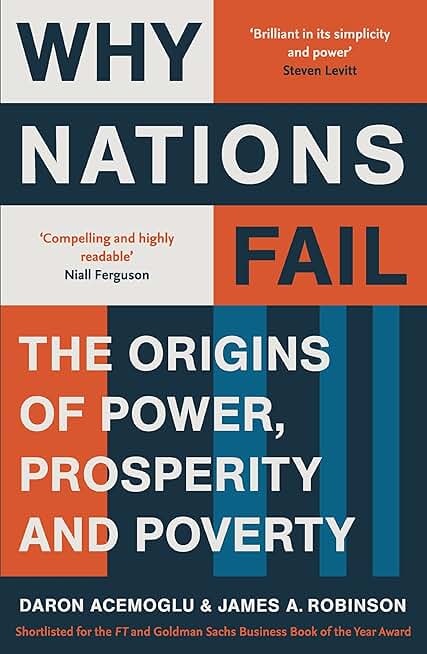
WHY NATIONS FAIL: THE ORIGINS OF POWER, PROSPERITY AND POVERTY
Shortlisted for the Financial Times and Goldman Sachs Business Book of the Year Award in 2012, this ambitious work by Daron Acemoglu and James A. Robinson tackles one of the oldest questions in economics: why do some countries thrive while others stay poor? Their answer is pointed and counterintuitive. It's not geography, climate, or cultural character. It's institutions. The structures that govern whether ordinary people can work, earn, and actually hold onto what they've built. That single thesis carries surprising weight across the book's sweeping historical canvas, which takes in ancient Rome, Tudor England, and present-day China, among many others. The core argument is straightforward but quietly radical: when institutions allow innovation and fair reward, prosperity tends to follow. When they don't, poverty digs in. Fifteen years of research sit behind this, and the authors engage seriously with rival thinkers, from Max Weber to Jared Diamond to Jeffrey Sachs, borrowing from the territory of Francis Fukuyama and Ian Morris along the way. The result is a rare kind of book, one that weaves economics, politics, and history into something genuinely readable. It won't satisfy every critic, but as a persuasive framework for understanding why wealth and poverty fall where they do, it's hard to put down.
- Author: Daron Acemoglu
- Publisher: Profile Books
- Genre: Economics
- ISBN: 978-1846684302
- Pages: 560 pages