
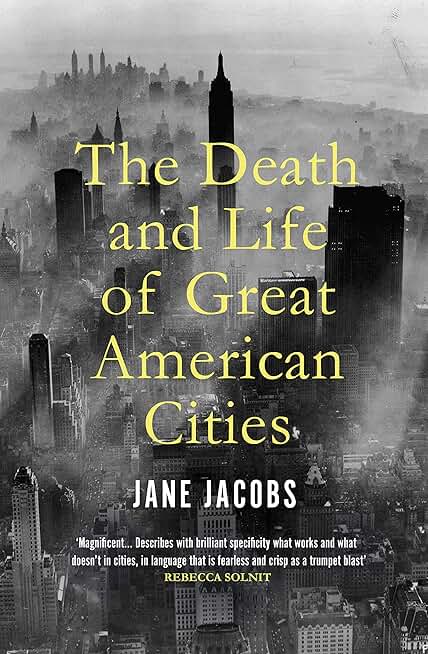
The Death and Life of Great American Cities
Published decades ago, Jane Jacobs's landmark work set out to do something bold: challenge the orthodoxies of city planning and propose a more humane alternative. It's a book that still feels urgent, and rightly so. Jacobs turns her attention to the post-war planners who reshaped urban life with grand, theoretical ambition but precious little street-level curiosity. Inspired by utopian visions like the Garden City or Le Corbusier's gleaming Radiant City, these architects of change pursued rigid scientific blueprints, vast open lawns, and self-contained residential blocks. The trouble is, none of it reflected how people actually live. What gives a city its real energy, Jacobs argues, is messiness: a variety of building ages, mixed uses, dense foot traffic, and spaces built to a human rather than monumental scale. Short blocks, old buildings alongside new ones, and streets busy enough to feel safe at any hour. These aren't accidents. They're conditions worth protecting and reproducing. The writing itself is a pleasure. Jacobs has a gift for making the familiar strange again, and you'll find yourself looking at your own neighbourhood differently by the final chapter. The New York Times Book Review once called it perhaps the most influential single work in the history of town planning, praising her narrative instinct, wit, and capacity to move the reader as well as persuade them. That verdict still holds.
- Author: Jane Jacobs
- Publisher: Vintage Digital
- Genre: Architecture
- ISBN: 978-1448180288
- Pages: 462 pages