
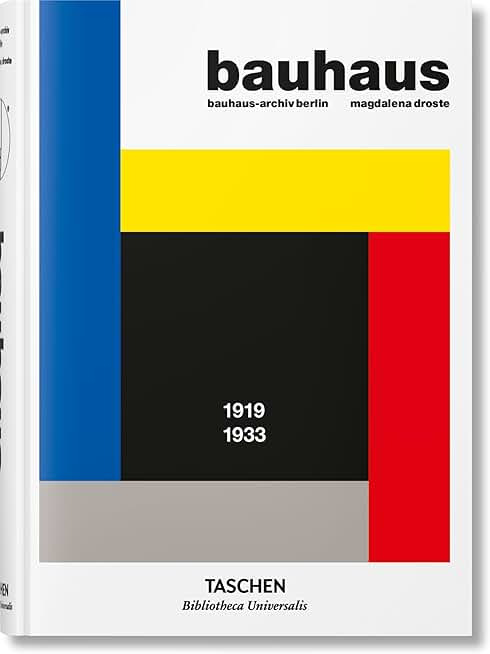
BAUHAUS
Between two world wars, Germany's Bauhaus school compressed a revolution into just fourteen years. It's a remarkable fact: that so brief an institution could so thoroughly reshape how we think about art, design, architecture, and the relationship between beauty and function. This substantial reference volume, produced in collaboration with the Bauhaus-Archiv in Berlin (home to the world's largest collection of Bauhaus material), makes a convincing case for why that legacy still resonates. The book draws on around 575 images: architectural plans, candid photographs, preparatory sketches, finished models, and more. Together they capture not just the finished work but the thinking behind it, and the personalities who drove it. You'll find informal snapshots of communal gymnastics sitting alongside drawings guided by Paul Klee, sweeping architectural blueprints next to Marianne Brandt's quietly perfect ashtray. The range is genuinely striking. What holds it all together is the school's founding conviction: that fine art, skilled craft, and industrial technology belonged in conversation with one another. Applied across disciplines from theatre to ceramics, film to sculpture, this philosophy produced work that was simultaneously rigorous and inventive. The book traces that work across the school's three locations in Weimar, Dessau, and Berlin, giving shape to both its evolution and its internal tensions. As a record of an idealistic creative community, it's thorough and absorbing. Figures including Josef Albers, Walter Gropius, Ludwig Mies van der Rohe, and Lilly Reich all feature, their contributions given proper weight. This is a focused, well-assembled account of a movement that proved art education could be genuinely radical.
- Author: Bauhaus-archiv Berlin
- Publisher: TASCHEN America Llc
- Genre: Architecture
- ISBN: 978-3836565547
- Pages: 549 pages