
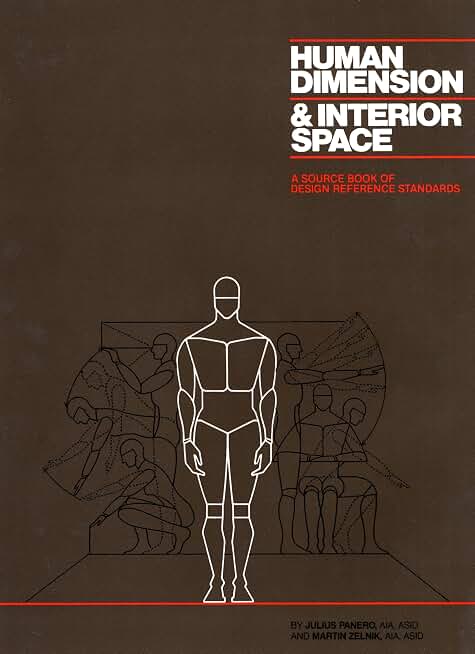
HUMAN DIMENSION & INTERI
Anthropometrics, the comparative study of human body measurements, sits at the heart of this landmark reference by Julius Panero and Martin Zelnik. It concerns itself with a deceptively simple question: how well does the human body actually fit the spaces we build around it? The answer, it turns out, is far more complicated than most designers assume. This book is the first major reference of its kind to ground interior design standards firmly in anthropometric data, and it speaks directly to architects, interior designers, furniture makers, builders, industrial designers, and design students alike. It's a resource built for the whole industry, not just one corner of it. The data here supplements professional judgement rather than replacing it, serving as one considered input among many in the design process. The book is structured in three parts, each doing its own distinct work. The opening section covers the theory and practical application of anthropometrics, with dedicated attention given to elderly people and those with physical disabilities. It gives designers a solid grounding in the fundamentals and explains how accepted interior standards actually come to be. The middle section presents illustrated anthropometric tables, clear and accessible, covering human body dimensions organised by age and percentile. Data on children's body sizes and the range of joint movement is included too. The final section is perhaps the most immediately useful: hundreds of dimensioned drawings showing, in plan and section, the correct spatial relationships between people and their environments. Spaces covered include residential, commercial, recreational, and institutional settings, with all figures given in both imperial and metric units. The epilogue takes a provocative turn. Panero and Zelnik challenge the persistent design myth of the 'average man', a statistical ghost who doesn't correspond to any real person, and argue that the industry must take adjustability far more seriously. Drawing on government research from distinguished figures at the Harvard School of Public Health and the U.S. Public Health Service, they present a coherent system of reference standards made accessible through charts and situation drawings. It's a genuinely thought-provoking call to rethink how we plan the spaces people actually inhabit.
- Author: Julius Panero
- Publisher: Watson-Guptill
- Genre: Architecture
- ISBN: 978-0823072712
- Pages: 320 pages